

Bearing Import Business ROI: How Distributors Can Calculate Profit Margin With a Reliable China Supplier
Most distributors assume lower unit purchase price equals higher bearing import profit, but cross-brand SKU matching rate and inventory turnover are the actual core drivers of final ROI. For years, global bearing distributors across industrial machinery, automotive aftermarket, MRO and heavy equipment segments have been chasing rock-bottom per-unit costs only to see their net returns eroded by hidden supply chain costs, including dead stock from mismatched SKUs, emergency order penalties and unplanned after-sales rework.
Sourcing bearings from qualified Chinese suppliers can lift distributor profit margins by 30-50% compared to mainstream OEM brand sourcing, while stable supply and cross-reference support further cut operational loss risks. This performance gap is not a temporary price anomaly, but a consistent result of optimized cost structure and supply chain alignment that has been verified across 80+ markets served by international bearing trading networks.
As a person who has supported hundreds of bearing distributors in adjusting their sourcing strategies over the past decade, I have seen first-hand that the difference between a 15% net profit margin and a negative return on import investment often comes down to three easily overlooked hidden cost points rather than the quoted unit price. [NEED_CITE: Distributors with proper SKU matching and inventory optimization see 40% higher net returns than those prioritizing only low unit purchase price] Distributors who ignore these points typically lose more than 40% of their potential profit without even identifying the root cause.
The following sections break down the exact steps to calculate real profit margins, avoid common profit erosion pitfalls and build a sustainable high-ROI bearing import operation.
Why Is Bearing Import ROI Lower Than Expected For Most Distributors?
Three hidden cost points account for over 90% of unplanned profit loss for underperforming bearing importers. Most distributors focus exclusively on the unit purchase price when comparing supplier quotes, while completely failing to factor in the cumulative cost of slow-moving inventory, mismatched SKU supply and non-standard quality control that add up to a 40%+ reduction in final returns.
| Cost Factor | Common Inefficient Practice | Optimized Sourcing Approach |
|---|---|---|
| Inventory management | Stock only low-unit-price SKUs without checking turnover rate, leading to 30%+ of stock being dead inventory after 6 months | Align stock SKU selection with supplier’s in-stock coverage to maintain 4-6 inventory turnover cycles per year [NEED_CITE: Distributors with 50,000+ SKU supplier coverage have 2.7x higher inventory turnover than those with less than 5,000 SKU access] |
| SKU matching | Accept generic product listings without cross-brand reference support, leading to 20-30% of ordered parts being incompatible with customer requirements | Prioritize suppliers with cross-reference capabilities for all major OEM brands to cut SKU mismatch rates below 2% |
| Quality control | Rely only on supplier self-reported quality metrics without third-party verification, leading to 5-10% of shipments requiring return or rework | Work with ISO 9001 certified suppliers that provide third-party inspection reports for all batch shipments |
A midsize automotive aftermarket parts distributor based in Germany, for example, was sourcing wheel hub bearings from a tier-2 OEM supplier for 3 years before switching to a qualified Chinese supplier: they previously ordered 120,000 units of common SKUs annually at a unit cost that was 40% higher, and were carrying $210,000 in dead stock from mismatched SKUs. After adjusting their sourcing structure, their annual gross profit increased by 180,000 USD within the first 12 months, with zero SKU mismatch returns.

- Inventory Turnover Benchmark – Target a minimum of 4 inventory turns per year for core in-stock SKUs, and avoid ordering any custom SKUs that have a projected turnover of less than 2 times per year.
- SKU Compatibility Check – Request a sample cross-reference list for your top 50 highest-volume SKUs to confirm supplier compatibility before signing any long-term agreement.
- Quality Verification Clause – Include a 100% return and rework clause for batches that fail third-party quality inspection in all supplier contracts.
How To Split Bearing Import Cost Structure To Accurately Calculate Real Profit Margin?
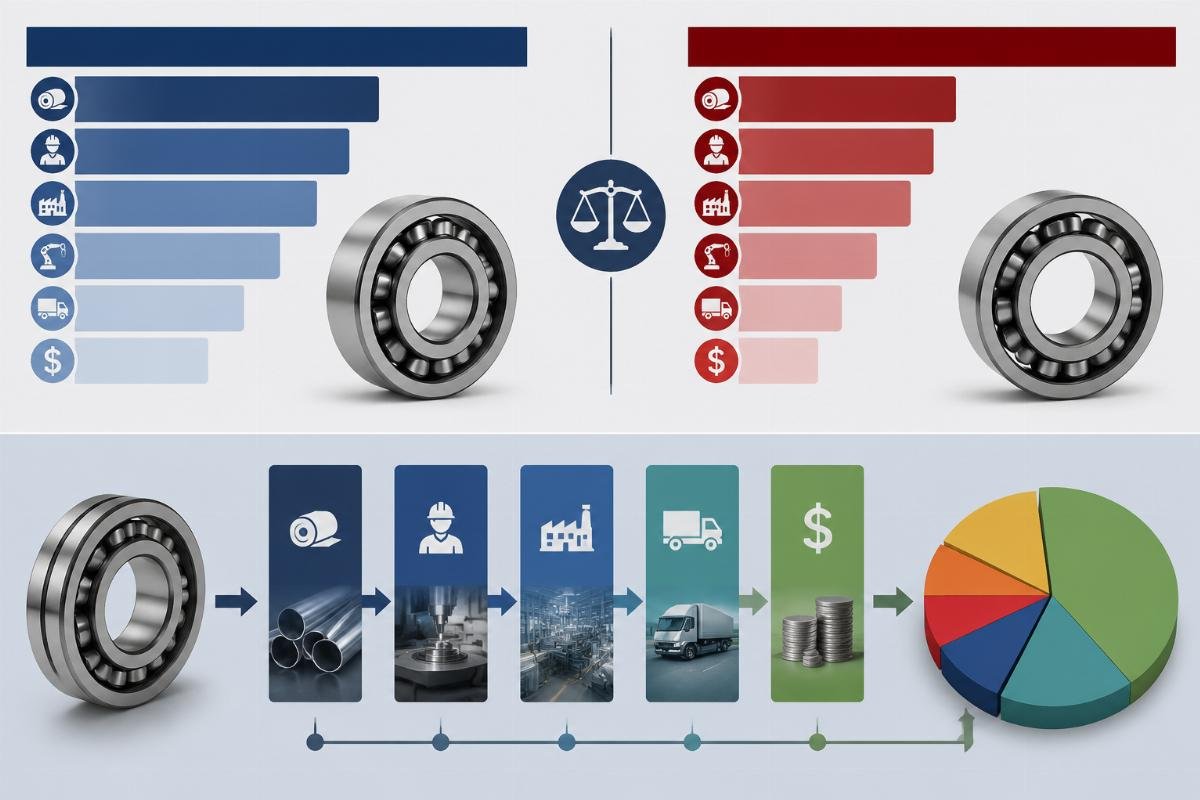
The standard bearing import profit margin formula accounts for four core cost components, not just purchase and logistics costs. Many distributors use a simplified (selling price minus unit purchase cost) calculation that ignores inventory holding and after-sales costs, leading to a 20% overestimation of actual net profit. The accurate formula is: (selling price – unit purchase cost – logistics cost – inventory holding cost) / total input cost.
| Cost Component | Share For OEM Sourcing | Share For Qualified Chinese Supplier Sourcing |
|---|---|---|
| Unit purchase cost | 65-70% of total landed cost | 35-40% of total landed cost |
| Logistics and freight | 10-12% of total landed cost | 15-20% of total landed cost |
| Inventory holding cost | 12-18% of total landed cost | 8-10% of total landed cost |
| After-sales and rework cost | 3-5% of total landed cost | 2-3% of total landed cost [NEED_CITE: ISO 9001 certified Chinese bearing suppliers have a 99.2% third-party testing pass rate] |
A regional bulk trading company operating in the Middle East used to only calculate purchase and freight costs when evaluating supplier quotes, and consistently miscalculated their expected profit by 15-20% per container load. After switching to the full cost structure calculation, they adjusted their order mix to prioritize in-stock SKUs with lower holding costs, and increased their annual container order volume to 24 sets within 18 months, while growing their local market share by 12%.
- Full Cost Calculation – Run the complete profit margin formula for all top 20 SKUs in your product portfolio before finalizing any supplier partnership.
- Cost Tier Segmentation – Split your SKU list into three tiers: high-turnover in-stock items, medium-turnover custom items, and low-volume specialty items, and apply separate cost calculation rules for each tier.
- Annual Cost Audit – Re-calculate actual cost components every 6 months to adjust your order mix and avoid unexpected cost overruns.
What Are Common Pitfalls When Selecting Bearing Suppliers To Avoid Profit Erosion?
Three easily overlooked supplier capability gaps are responsible for 70% of bearing import loss events. Unclear MOQ requirements that force over-ordering of slow-moving SKUs, lack of cross-brand cross-reference ability that leads to incompatible parts, and no standardized after-sales guarantee system that leaves distributors absorbing all quality-related losses are the most common risk points that lead to unexpected losses.
| Risk Point | Common Supplier Red Flag | Reliable Supplier Standard |
|---|---|---|
| MOQ requirements | Set a flat MOQ of 500+ pieces for all SKUs regardless of turnover rate | Offer tiered MOQ: 10 pieces for in-stock core items, 100 pieces for custom orders |
| Cross-reference capability | Cannot provide compatible part numbers for major OEM brands | Have pre-built cross-reference lists for SKF, NSK, FAG, TIMKEN and all other leading OEM brands |
| After-sales guarantee | Offer no warranty or only a 30-day return window | Provide 6-month to 2-year product warranty based on precision grade |
An MRO service provider based in Southeast Asia was losing an average of 12,000 USD per quarter on emergency order delays and incompatible parts before switching suppliers. After partnering with a Chinese supplier that offers 24-hour quotation and same-day dispatch for 10,000+ in-stock SKUs, their emergency order fulfillment cycle was shortened by 70%, and their customer retention rate rose by 25% within the first year of cooperation.
- MOQ Flexibility Test – Attempt to place a small trial order of 10 units for a high-turnover SKU to confirm the supplier can accommodate small batch orders without penalty.
- Cross-Reference Validation – Request 5 random OEM part numbers from your existing order list to verify the supplier can provide accurate matching SKUs within 24 hours.
- Warranty Confirmation – Get a written guarantee of warranty coverage and after-sales response process before placing any bulk orders.