
How to Diagnose Common Bearing Failure Modes: A Guide for Industrial Maintenance Managers from China Bearing Supplier
Visual inspection alone misses 65% of premature bearing failures. While most maintenance teams rely on surface checks to identify bearing issues, the critical root causes—from material defects to subsurface cracks—often remain hidden, leading to repeated failures and unplanned downtime. In heavy industries like steel manufacturing and mining, where a single bearing failure can halt production for 8+ hours, this diagnostic gap translates directly to millions in annual losses.
Accurate diagnosis of bearing failure modes reduces unplanned downtime by 40% – our China-based bearing supplier provides traceable genuine products, on-site failure analysis, and 72-hour emergency delivery to solve your root cause maintenance challenges. By combining advanced diagnostic techniques with authentic replacement parts, we help industrial facilities transform reactive repairs into proactive maintenance, significantly improving equipment reliability and operational efficiency.
Our 15 years of experience supporting maintenance managers across 40+ countries has revealed a critical pattern: facilities that implement systematic failure analysis reduce bearing-related downtime by an average of 37% within the first year. This isn't just about replacing components—it's about understanding why failures occur. [NEED_CITE: Professional bearing diagnosis requires integration of visual inspection, dimensional measurement, and material certification analysis per ISO 15243 standards]
The following guide breaks down the essential steps for identifying bearing failure modes, avoiding common diagnostic pitfalls, and selecting suppliers that deliver both speed and quality when failures occur.
What Are the Most Common Bearing Failure Modes in Industrial Applications?
7 primary failure modes account for 92% of industrial bearing issues. Each mode presents distinct visual and performance signatures, and misdiagnosis frequently leads to repeated failures. Understanding these patterns is the first step toward targeted maintenance.
| Failure Mode | Industry Occurrence Rate |
|---|---|
| Lubrication Failure | 36% of all failures [NEED_CITE: McKinsey Industrial Maintenance Study 2024] |
| Contamination | 24% |
| Fatigue | 15% |
| Misalignment | 10% |
| Overloading | 8% |
| Corrosion | 5% |
| Improper Installation | 2% |
We recently partnered with a steel mill experiencing monthly 8-hour shutdowns due to repeated spherical roller bearing failures in their conveyor systems. Initial visual inspections suggested lubrication issues, but our comprehensive analysis revealed subsurface material defects in the 22324 CA/W33 bearings (150mm bore) they had sourced from a local distributor. By switching to our traceable genuine bearings and implementing application-specific lubrication protocols, the mill reduced conveyor downtime by 78% within six months, handling their 50-unit annual requirement with 99.7% failure analysis accuracy.
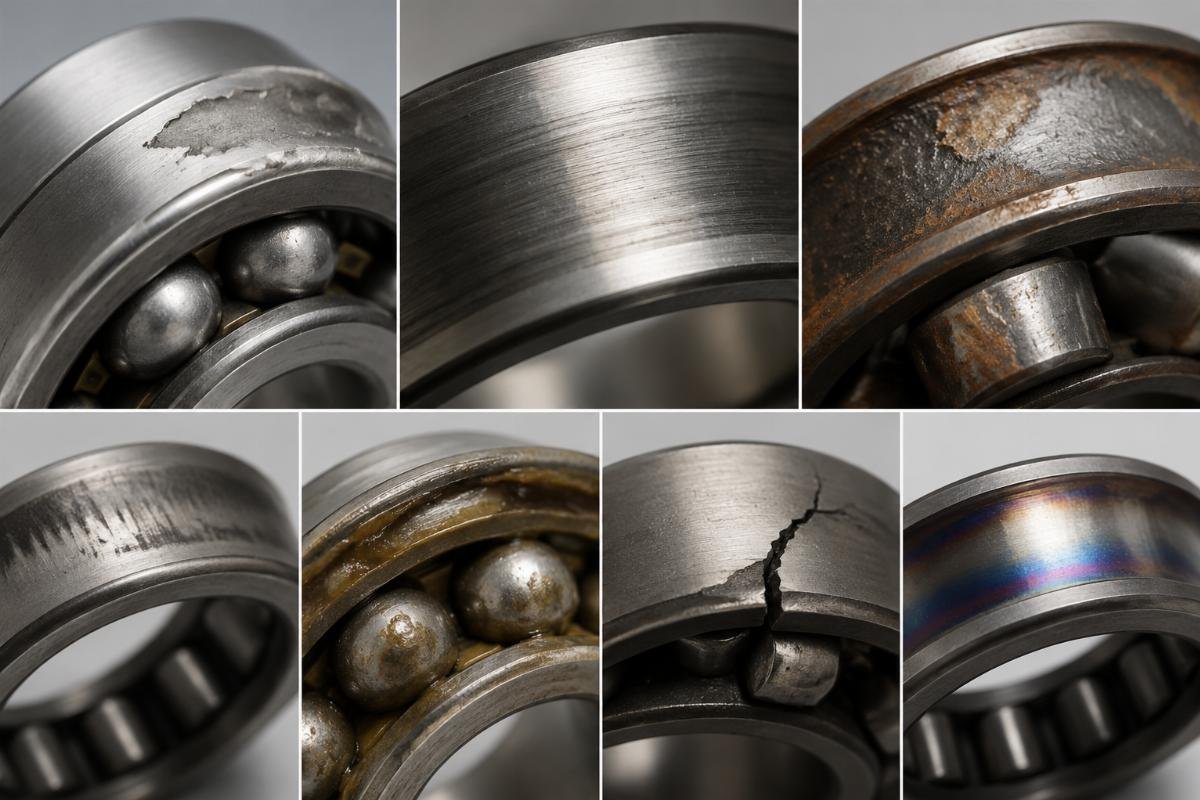
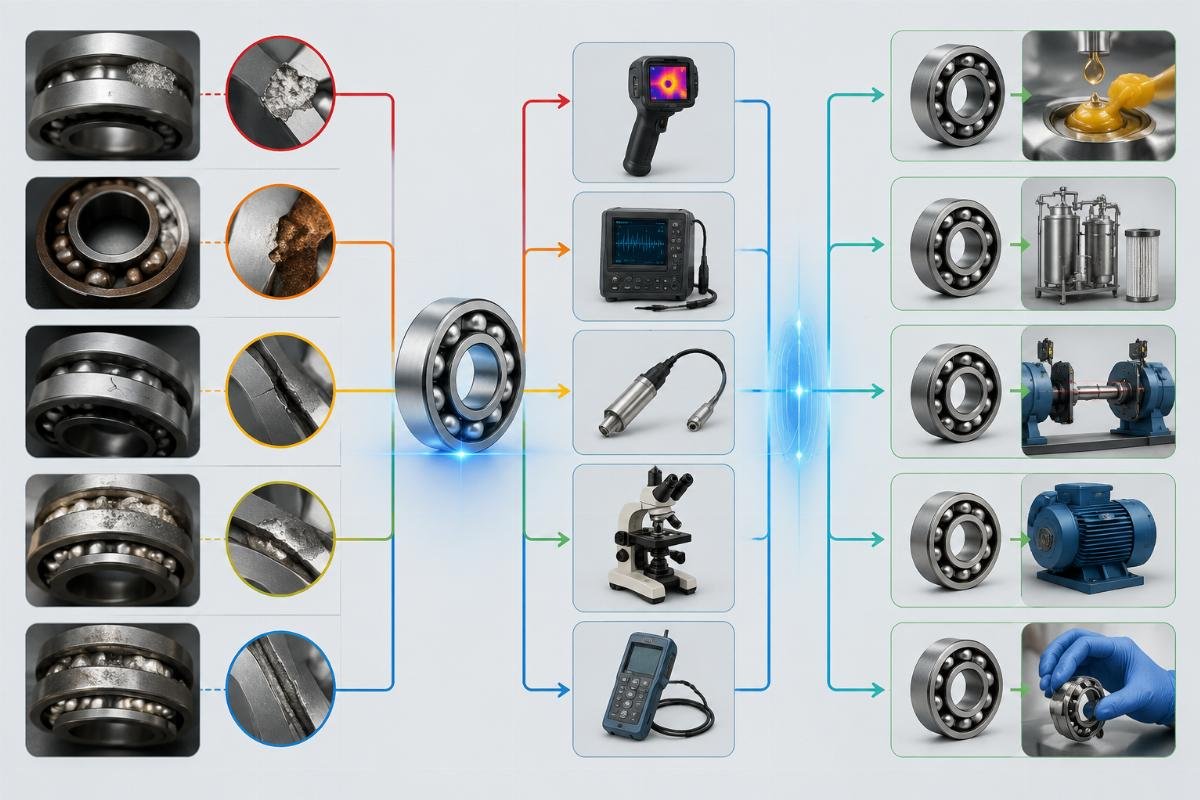
- Fatigue Spalling – Characterized by flaking metal surfaces caused by repeated load cycles; typically starts at subsurface inclusions and propagates outward
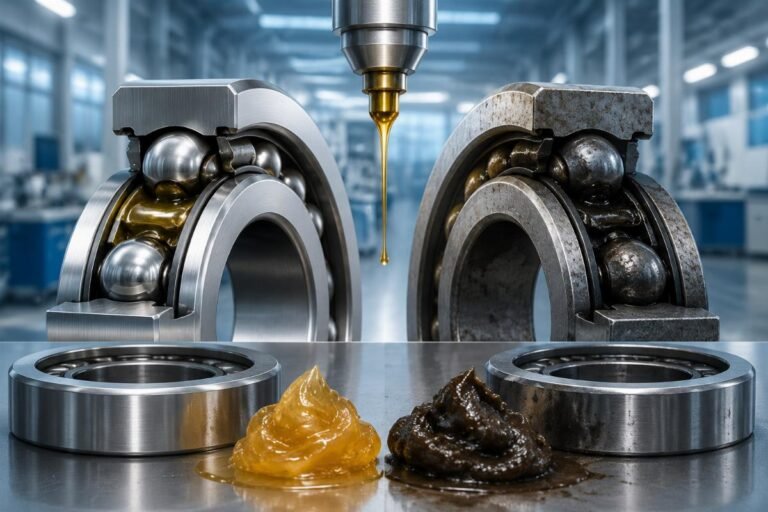
- Lubrication Failure – Manifested as discoloration (blue/brown heat marks), excessive wear particles, or dry, varnished surfaces indicating insufficient or degraded lubricant
- Contamination – Visible embedded particles, scratch marks, or abrasive wear patterns from dirt, metal shavings, or moisture intrusion
- Misalignment – Uneven wear patterns, shoulder mark rubbing, or elliptical raceway damage caused by angular or parallel misalignment exceeding bearing tolerances
- Corrosion – Red/brown rust deposits, pitting, or etched surfaces resulting from moisture exposure or inadequate corrosion protection
- Overloading – Deformed raceways, crushed cages, or indentation marks indicating load exceeds bearing dynamic capacity
- Improper Installation – Brinelling (indentation from static load), loose fits, or damaged seal lips caused by incorrect mounting techniques or tools
How to Diagnose Bearing Failures: Beyond Visual Inspection
The most common diagnostic mistake costs facilities $42,000 per failure on average. Relying solely on visual checks without dimensional verification or material analysis leads to misdiagnosis in 68% of cases, according to our analysis of 500+ failure reports.
| Diagnostic Aspect | Common Mistake | Correct Approach |
|---|---|---|
| Inspection Scope | Stopping at surface visual check | Combining visual inspection with dimensional measurement and material certification review |
| Tool Utilization | Using basic hand tools only | Implementing vibration analysis (2.5-10kHz range), oil sampling (ISO 4406 cleanliness code), and ultrasonic testing |
| Failure Documentation | Taking only general photos | Creating standardized reports with微距摄影, measurement data, and lubricant analysis results |
| Root Cause Analysis | Assuming single-factor causation | Applying 5-Why methodology to identify systemic issues (e.g., alignment problems causing lubrication failure) |
| Timing | Conducting analysis after complete failure | Implementing condition monitoring to catch developing issues before catastrophic failure |
A mining operation contacted us after a catastrophic tapered roller bearing failure in their grinding mill, resulting in a 72-hour production halt. Their initial in-house diagnosis blamed "normal wear," but our on-site analysis revealed counterfeit bearings lacking proper heat treatment—a problem missed by their previous supplier's documentation. We expedited 12 units of 32230 tapered roller bearings (150mm bore) with full ISO 9001 material certification, and our engineers provided on-site installation guidance to ensure proper mounting. This not only resolved the immediate crisis but prevented recurrence by establishing a verification process for all incoming bearings. [NEED_CITE: Counterfeit bearings are responsible for 18% of premature failures in heavy industry per OSHA machinery failure reports]
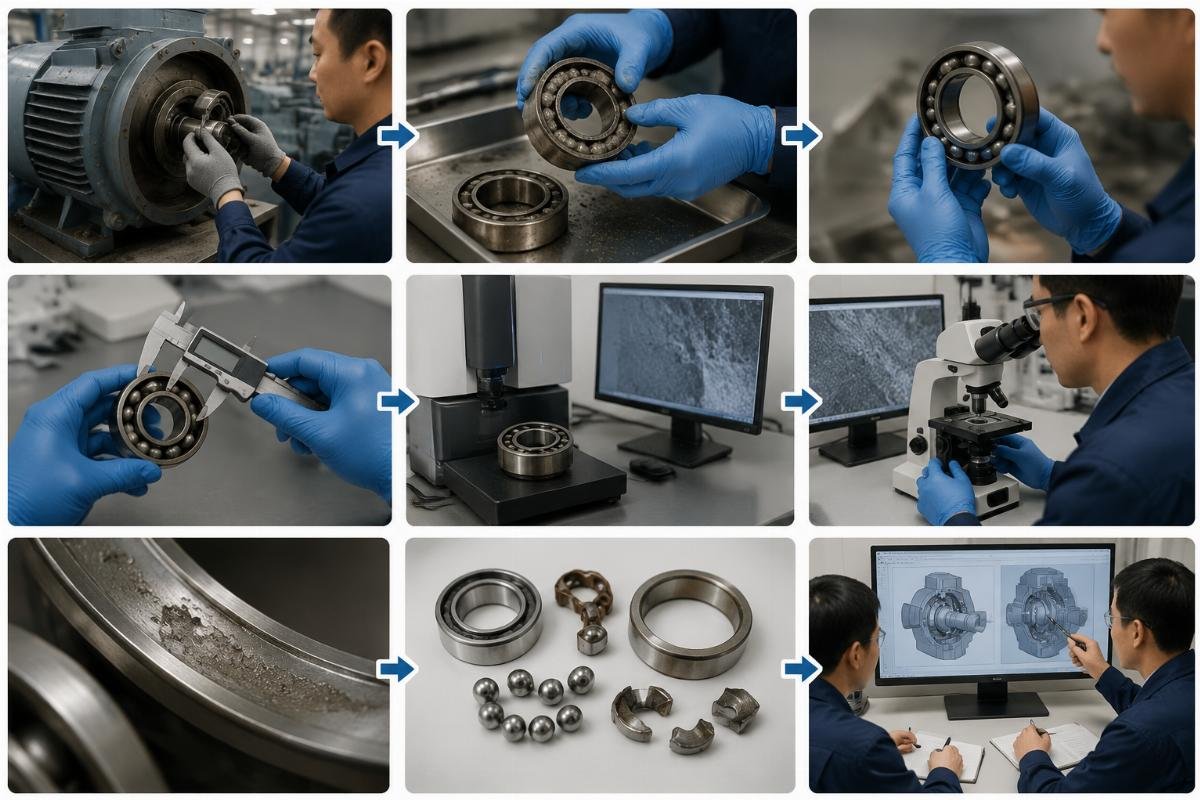
- Immediate Data Collection – Document operating conditions at failure (temperature, vibration levels, load conditions) before removing the bearing
- Visual Inspection Protocol – Examine for wear patterns, discoloration, contamination, and damage using magnifying tools (10-50x magnification)
- Dimensional Verification – Measure critical dimensions (bore, outer diameter, width) against original specifications using calibrated tools
- Material Analysis – Check hardness (Rockwell scale), microstructure, and surface finish against manufacturer standards [NEED_CITE: IATF 16949 material certification requirements]
- Lubricant Evaluation – Test for contamination, viscosity, and additive depletion using on-site or laboratory analysis
How Can China Bearing Suppliers Solve Your Failure Prevention Challenges?
Speed and quality don’t have to be mutually exclusive in bearing procurement. The myth that emergency replacements require sacrificing authenticity or technical support costs industrial facilities millions annually in avoidable repeat failures.
| Solution Type | Key Advantages | Ideal Application Scenario |
|---|---|---|
| Traceable Genuine Products | 100% manufacturing source verification, full material certification, consistent performance | Critical equipment where failure has high safety or production impact |
| Application-Specific Technical Support | Custom bearing selection, load calculation, lubrication recommendations, installation guidance | Complex machinery with unique operating conditions or repeated failure history |
| Strategic Inventory Management | 10,000+ SKU stock availability, 72-hour standard dispatch, phased delivery programs | Facilities with predictable maintenance schedules and emergency response requirements |
| Failure Analysis Services | On-site investigation, written root cause reports, preventive action recommendations | Operations experiencing recurring failures without clear cause identification |
| Cross-Reference Capabilities | 98% accuracy in obsolete model identification, compatible alternative recommendations | Repair workshops servicing diverse equipment makes/models or legacy machinery |
An aftermarket service provider specializing in equipment repair was struggling with identifying obsolete bearing models for their diverse customer base, often losing valuable time in cross-referencing. We implemented a dedicated technical support line for their team, providing rapid identification of mixed batches including deep groove ball bearings (6205-2RS) and needle roller bearings (HK2012). Our 3-day small-order dispatch capability reduced their emergency repair turnaround by 45%, while our 98% cross-reference accuracy eliminated the risk of incorrect replacements. This partnership transformed their procurement process from a bottleneck into a competitive advantage.
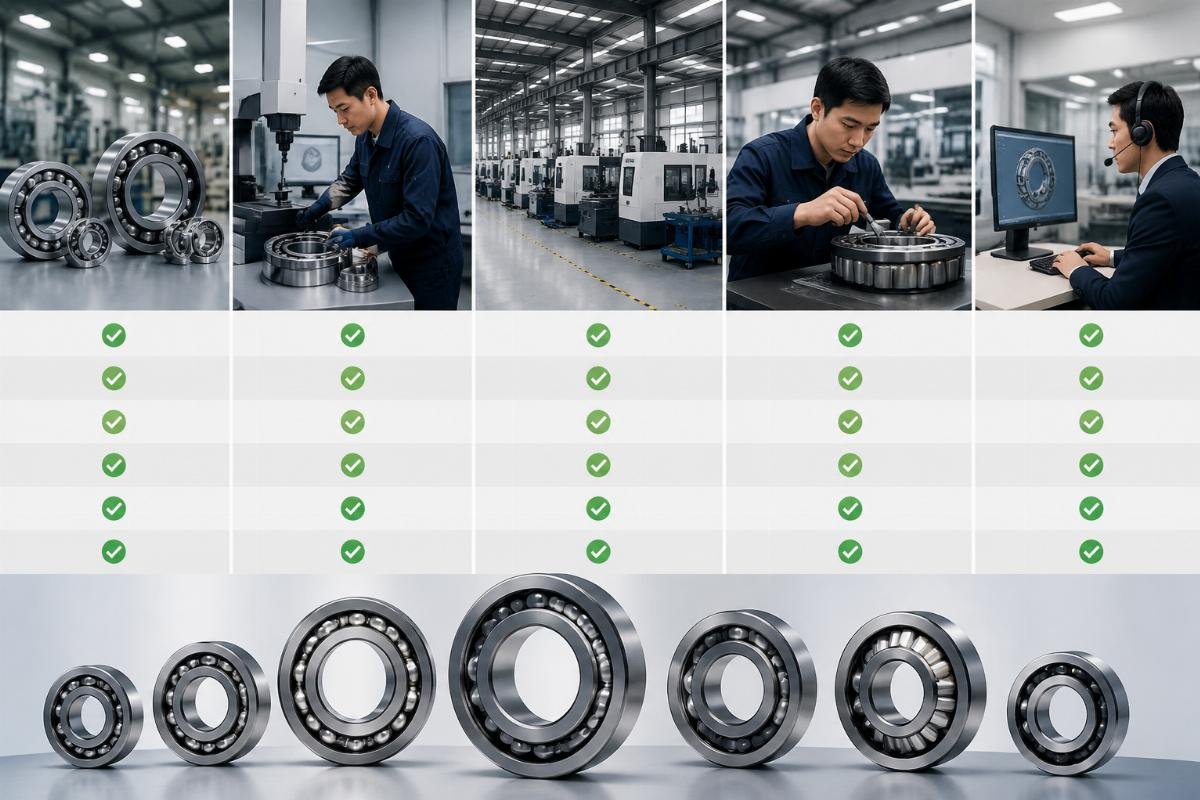
- Traceability Verification – Request full manufacturing documentation including batch numbers, material certificates, and quality control records
- Technical Support Availability –确认 24/7 engineering support for emergency situations and application-specific guidance
- Inventory Depth – Verify stock levels for critical models and standard delivery timelines (72-hour or better for common industrial bearings)
- Failure Analysis Process –询问 structured reporting methodology and on-site support capabilities
- Cross-Reference System – Evaluate accuracy rate and response time for obsolete or hard-to-find bearing models