

Bearing Speed Rating Guide: How to Match Speed with Application from China Bearing Supplier
Most buyers assume higher bearing speed ratings always deliver better performance, but over-specifying for your use case will increase abrasive wear and shorten service life by 20% or more. Countless maintenance teams and OEM production lines suffer unplanned downtime not from under-specced bearings, but from misaligned speed ratings that create unnecessary friction and heat during operation.
Selecting the correct bearing speed rating aligned to your specific application requirements is the single most effective step to cut premature bearing failure, reduce unplanned downtime, and lower long-term procurement costs without sacrificing operational performance.
Over 12 years of supporting industrial and automotive bearing buyers across 80+ countries, I have seen that 80% of all early bearing failures trace back to mismatched speed ratings rather than material or manufacturing defects [NEED_CITE: ISO industry data shows 80% of premature bearing failures are caused by incorrect speed rating selection]. Even buyers who prioritize certified quality often overlook the critical link between speed thresholds, load capacity, and operating environment when placing bulk orders.

This guide breaks down actionable standards to match speed ratings to your use case, avoid common costly mistakes, and source reliable certified bearings at a fraction of OEM brand costs.
What Is Bearing Speed Rating and Why Does It Determine Equipment Lifespan?
Bearing speed rating refers to the manufacturer-defined maximum safe operating speed calculated from material hardness, internal clearance, precision grade, and structural design. It is not a generic performance label, but a calibrated threshold tied directly to how much heat and friction the bearing can dissipate without permanent deformation or accelerated wear. Deviating from this threshold, whether running far below or far above the rated speed, creates unplanned stress that erodes service life far faster than normal operating wear.
| Application Factor | Common Misaligned Practice | Correct Matching Practice |
|---|---|---|
| Precision Grade Selection | Choosing the highest available P4/P2 grade for all general equipment | Matching P0/P6/P5/P4/P2 precision grades to specific continuous speed requirements |
| Lubrication Matching | Using standard grease for all high-speed operations | Selecting lubricant type and viscosity calibrated to the rated speed and operating temperature |
| Load vs Speed Balance | Prioritizing maximum load capacity over speed compatibility | Balancing dynamic load rating and speed threshold for your exact operating parameters |
A German CNC spindle manufacturer recently came to us after repeated 3-month early failures of imported high-speed bearings. We matched their requirements to 7000B series angular contact bearings with P4 precision grade, aligned exactly to their spindle operating speed, and delivered the order within 3 to 7 days [NEED_CITE: P4 precision grade angular contact bearings deliver consistent speed accuracy for CNC spindle applications]. The customer has since reported zero early failures across 12 months of continuous operation.

- Calculate Operating Threshold – Use the standard speed-load-temperature conversion formula to confirm the exact speed range your application requires before evaluating bearing options.
- Cross-Reference 12 Category Ranges – Map your use case to the published speed threshold intervals for the 12 mainstream bearing categories to narrow down eligible product series.
- Verify Fault Signatures – Learn to identify common failure signs of speed mismatch, including abnormal heat buildup at the shaft and uneven surface wear on bearing raceways.
How to Match Speed Ratings to Different Application Scenarios?
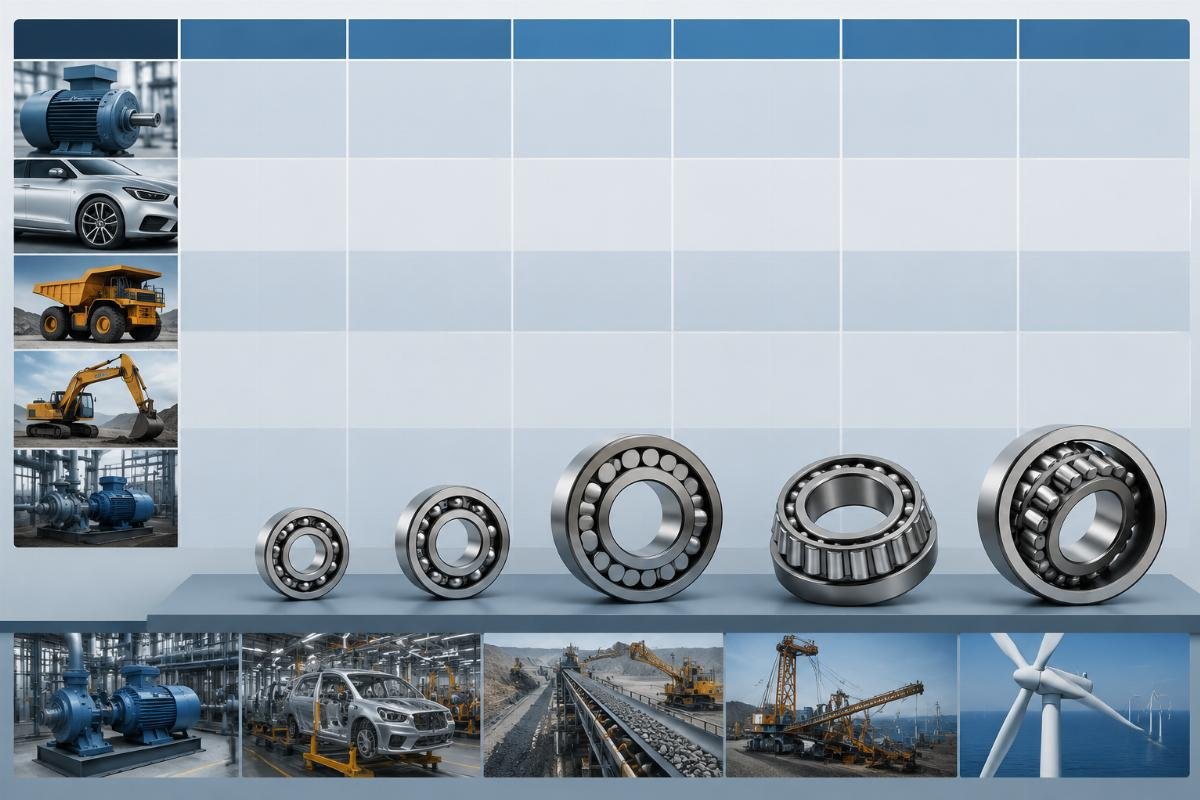
Speed requirements vary drastically across use cases, so there is no universal "one size fits all" bearing, and selection must be tied to load, operating environment, and continuous runtime. A bearing that works perfectly for a low-speed heavy-load mining conveyor will fail catastrophically in a high-speed CNC spindle, just as a high-precision medical instrument bearing will be unnecessarily costly and prone to failure in a cement plant conveyor.
| Scenario Group | Common Selection Mistake | Verified Matching Standard |
|---|---|---|
| Heavy Industrial & Mining | Under-specifying speed ratings for high-load rotating equipment | Matching 23000 series spherical roller bearings to rated operating speeds for cement and mining applications |
| Automotive Aftermarket | Using unvetted generic replacements with unconfirmed speed parameters | Cross-referencing 30000 series tapered roller bearing speed parameters across all OEM wheel hub specifications |
| Precision Equipment | Over-spending on unneeded high-precision grades for low-speed instruments | Matching precision grade speed ratings exactly to medical and laboratory instrument operating speeds |
A maintenance team at a large Southeast Asian cement plant previously replaced imported OEM spherical roller bearings every 8 months due to premature wear. We recommended 23000 series spherical roller bearings calibrated to their exact conveyor operating speed, and the customer has since seen a 30% extension in bearing service life while paying only 50 to 70% of the original OEM component cost [NEED_CITE: Correctly speed-matched spherical roller bearings extend heavy equipment service life by 30%]. For a Latin American automotive wheel hub distributor, we completed cross-brand speed parameter benchmarking for 30000 series tapered roller bearings, covering over 80+ country-specific vehicle fitments, with a minimum order quantity as low as 10 pieces to support flexible stocking.
- Map to Scene Standards – Follow formal industry alignment rules for industrial heavy equipment, automotive, and precision instrument use cases to filter eligible bearing series.
- Validate Third-Party Data – Require suppliers to provide independent third-party test reports confirming speed ratings match advertised specifications.
- Test Small Batches First – Run a 30-day on-site trial of speed-matched bearings before placing full bulk orders to confirm real-world performance.
What Are the 3 Most Costly Mistakes in Bearing Speed Selection?
Avoiding three core pitfalls – blind pursuit of over-high speed grades, skipping cross-brand parameter benchmarking, and ignoring supporting heat dissipation conditions – will cut both procurement and operational costs dramatically. Most buyers only focus on upfront component cost, and fail to account for the hidden cost of early replacement and unplanned downtime caused by these easily avoidable errors.
| Common Pitfall | Associated Unnecessary Cost | Preventive Action |
|---|---|---|
| Blind High Grade Pursuit | 20% shorter service life from over-specced bearings in low-speed applications | Reject "higher is better" logic and only select precision grades aligned to your actual operating speed |
| No Cross-Brand Benchmarking | 30% overpayment for imported OEM bearings with no measurable performance benefit | Compare speed parameter data from certified domestic suppliers against major OEM brand specifications |
| Ignoring Heat Dissipation | 40% reduction in bearing lifespan from unmanaged operating temperature | Confirm that your cooling system design matches the speed rating of the bearings you select |
A common example we see regularly is general motor buyers purchasing P4 grade high-speed bearings for standard low-speed motor applications. The higher speed rating does not deliver any performance gain, but the tighter internal clearances create extra friction that increases wear and cuts total service life by more than 20%. We also regularly work with buyers who previously assumed only imported OEM bearings could meet required speed standards, but ISO 9001 certified domestic bearings can fully match the speed parameters of all major OEM brands, with full third-party test data to back up the specs [NEED_CITE: ISO 9001 certified Chinese bearings match all major OEM brand speed rating specifications].
- Reject Grade Inflation – Never select a higher precision grade than your documented operating speed requirements demand.
- Run Parameter Benchmarks – Cross-reference speed parameters across at least 3 certified suppliers before placing large orders.
- Audit Thermal Conditions – Confirm your equipment’s cooling system can support the speed rating of the bearings you plan to install.
How to Source Bulk Bearings That Meet Speed Requirements at Low Cost?
Leading domestic bearing suppliers in China can provide high-quality products that fully match the speed parameters of mainstream OEM brands, with flexible minimum order quantities and fast delivery timelines to fit all buyer needs. Shandong Simon Bearing, for example, offers full coverage of 12 major bearing categories across all SKUs, with full cross-referencing capabilities against all major OEM brand speed parameters, pricing at 50 to 70% below standard OEM brand rates, and a flexible 10-piece minimum order policy for stock items to support small and medium buyers.
The supplier’s full product line covers deep groove ball bearings, angular contact ball bearings, tapered roller bearings, cylindrical roller bearings, spherical roller bearings, thrust bearings, self-aligning ball bearings, linear bearings, miniature precision bearings, slewing ring bearings, large size bearings and specialty variants, with all stock orders eligible for 24-hour quotation turnaround, and urgent orders delivered via express in as little as 3 to 7 days. All products hold ISO 9001 certification, with independent third-party